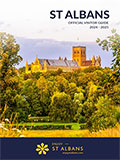
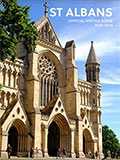
St Albans is a unique English Cathedral City in Hertfordshire, named after Alban, Britain's first Christian martyr, who was executed in the 3rd century AD. Built on and around the site of Verulamium, once the third-largest city in Roman Britain, St Albans layers nearly two thousand years of history into a compact and welcoming destination. From Roman mosaics to a Norman cathedral and a thriving modern high street, the city offers something remarkable at every turn.
The Roman municipium of Verulamium was founded after the invasion of AD 43 and grew to cover more than 100 acres before its walls were raised around 270 AD. Today the 102-acre Verulamium Park preserves stretches of those ancient walls and the outline of the London Gate, while the on-site Verulamium Museum houses in-situ mosaics and a well-preserved hypocaust. The park itself is a lush green space ideal for a leisurely afternoon walk alongside the River Ver.
St Albans Cathedral, built in part from Roman brick salvaged from Verulamium, dominates the city skyline and is one of the finest Norman abbey churches in England. Below it, the Charter Market has traded on the same streets since it was founded by Abbot Wulsin of St Albans Abbey around 860 AD, making it the oldest market in England still held on its original site. The historic streets surrounding the market are lined with independent retailers, boutiques, and cafes that sit alongside familiar high-street names.
St Albans has a well-earned reputation for its pubs, restaurants, and food culture. Ye Olde Fighting Cocks, a distinctive octagonal pub beside the River Ver, is one of England's most historically notable drinking establishments, with roots claimed as far back as the 8th century. Throughout the year the city hosts a packed programme of events including the Alban Weekend, the St Albans Food and Drink Festival, a popular Christmas Market, and a wide range of arts and cultural festivals.
St Albans sits in Hertfordshire just 20 miles north of central London, with fast rail links from St Albans City station and St Albans Abbey station, as well as easy access to major airports. The surrounding countryside includes Heartwood Forest, part of England's largest new native woodland, making the city an excellent base for both urban exploration and rural walks.
Alban was a citizen or soldier of Roman Verulamium who sheltered a Christian priest named Amphibalus and converted to Christianity. He was condemned to death for his faith, likely in the 3rd century AD, and became Britain's first Christian martyr. A shrine to Alban was established on the site of his execution, which eventually grew into the Abbey and then the Cathedral that still bears his name today.
Verulamium was the Roman name for the settlement on which St Albans grew. At its peak in the 2nd and 3rd centuries AD it was the third-largest city in Roman Britain, complete with a forum, basilica, public baths, temples, and a theatre. Visible remains, including a section of the Roman city wall and the reconstructed outline of the main gate, can be found in Verulamium Park. The Verulamium Museum within the park displays in-situ mosaic floors and a hypocaust heating system.
The market was founded around 860 AD by Abbot Wulsin of St Albans Abbey, making it over a thousand years old. A Royal Charter confirming Wednesday and Saturday trading days was granted by Edward VI in 1553. Following the closure of Canterbury Market in 2022, St Albans Charter Market is now considered the oldest market in England still operating on its original site, and in 2024 it was named Best Large Outdoor Market in Britain.
Yes. St Albans is approximately 20 miles north of central London and is well served by rail. Trains from London St Pancras reach St Albans City station in around 20 minutes via Thameslink, making it a straightforward day trip or short break destination. The city is also close to the M1 and M25 motorways and within reasonable distance of Luton, Heathrow, and Stansted airports.
The city hosts a variety of festivals and events throughout the year. Highlights include the Alban Weekend (a large free community festival), the St Albans Food and Drink Festival, the St Albans Christmas Market, the St Albans Film Festival, and regular open-air theatre and music events. The Cathedral also hosts its own programme of concerts, exhibitions, and seasonal services.
Verulamium Park is the city's main green space, covering 102 acres along the River Ver with a boating lake, putting green, and open meadows. Beyond the city, Heartwood Forest near Sandridge is part of one of England's largest new native woodland planting projects, offering miles of waymarked walking trails. The broader Hertfordshire countryside provides further opportunities for cycling, walking, and wildlife watching.
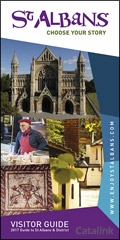
Enjoy St Albans is still running. For current information on St Albans visit www.enjoystalbans.com. This catalogue is no longer available through Catalink.

This brochure is no longer available
The St Albans Brochure brochure has been archived — details above are kept for reference. Browse similar live offers available free today.
Browse Live Brochures →Similar to St Albans Brochure and available now — order any of them free.

Order a free copy of the Lands End Clothing Catalogue now and discover beautiful clothing for the whole family!